EE3 Parallel SCARA Robot
Installation
Bachelor's thesis · KU Leuven, Group T · with Marcis Livmanis, Monique Pedroso dos Santos Gamiz Mainardes, Jan Rutrle
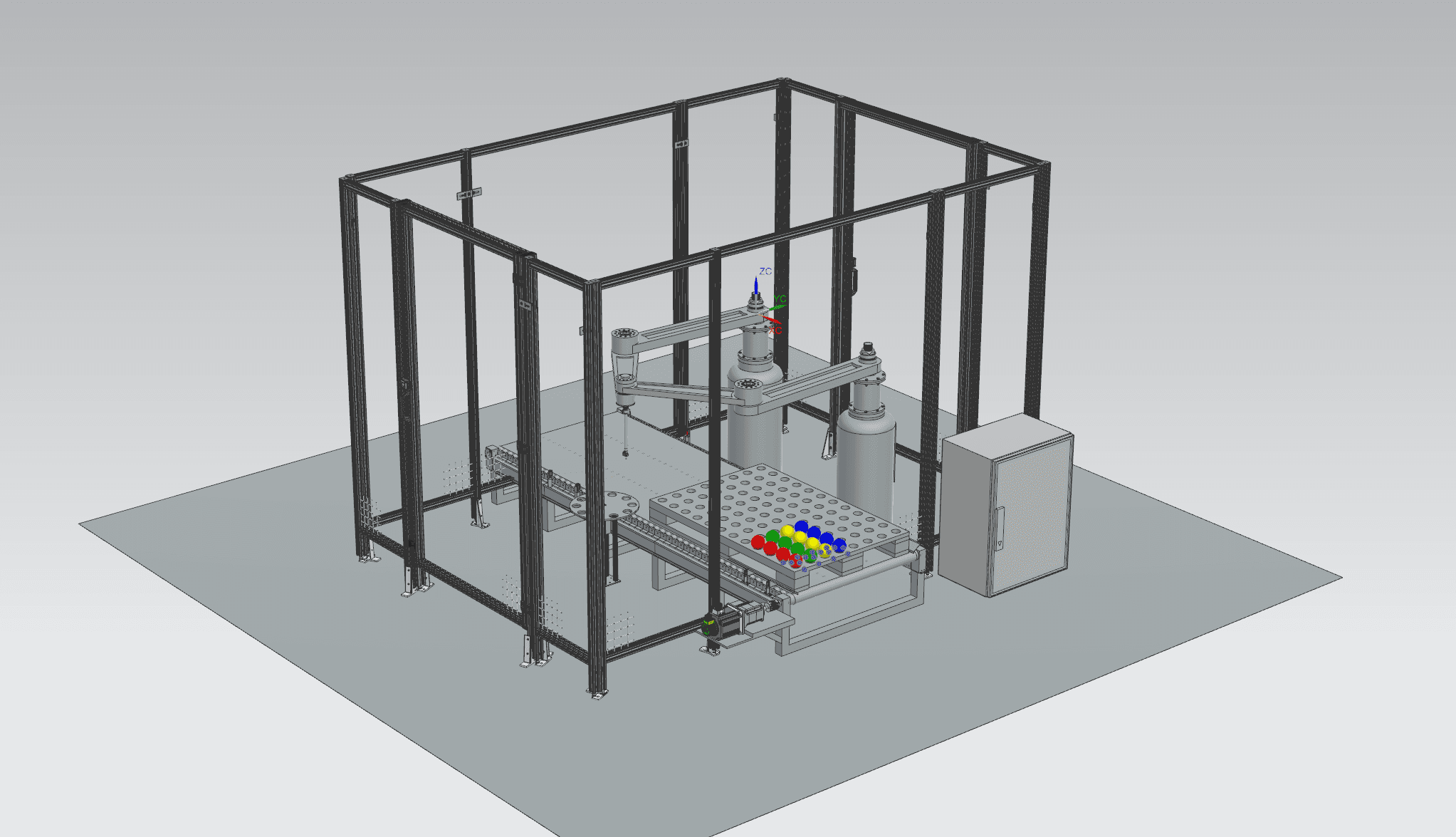
Overview
The EE3 project at KU Leuven Group T asked our team to design, from scratch, a complete automated palletizing cell for pétanque balls (0.75 kg, 75 mm steel balls) arranged on a standard euro pallet in an 8×12 grid.
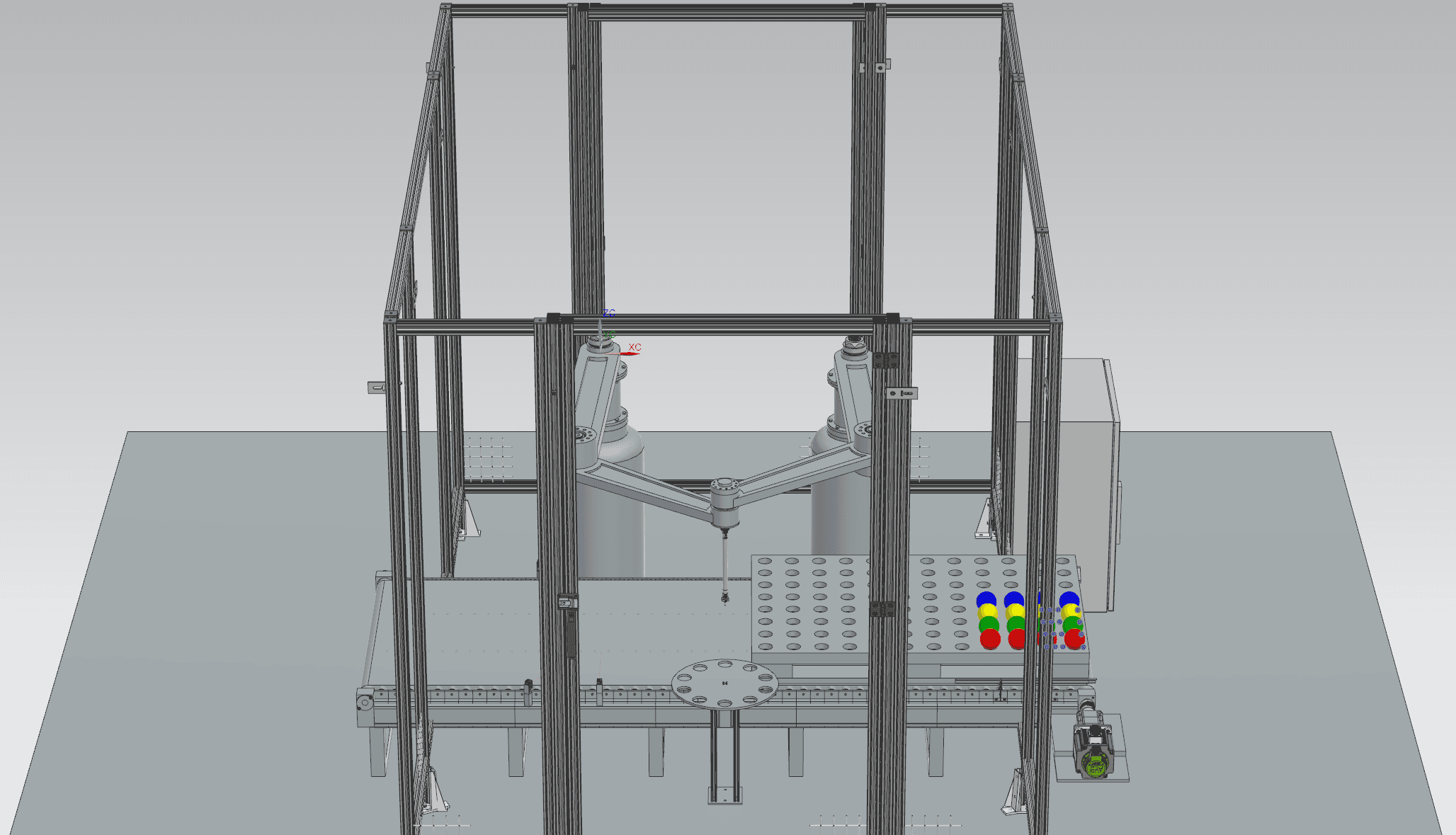
The result is a four-part installation: a conveyor belt feeding pallets into the work area, an indexing table holding the ball supply, a set of base tubes carrying the structure, and a parallel-arm SCARA robot with a reach of over 1.5 m doing the pick-and-place. Mechanical design, component selection, electrical schemes, PLC logic, and a digital twin were all part of the deliverable.
Mechanical Design
The full assembly was modelled in Siemens NX. The SCARA itself is a parallel arm configuration: two aluminium arm sets (50 kg combined) driven by two Allen-Bradley medium-inertia servo motors at 120°/s and 480°/s². Joints, bearings, and the conveyor and indexing table mechanisms were all sized through component-level calculations, including bearing life and shaft loading.
A full ISO 14121 risk assessment was conducted across the installation: hazard identification, risk indexing, and selection of preventive measures (light curtain, two-channel safety, guard rails, safe-stop modes via the servo drives), following ISO 12100 for the implemented safety functions.
Individual Paper
My individual contribution, submitted as a Procedia CIRP-style paper, took the finished SCARA design and asked: what else could this robot do? The pétanque cell was its first application, but the mechanical platform had headroom for a much wider range of loads and cycle times.
A static FEA was set up in Siemens NX on a simplified arm model, sweeping loads from ~4 kg up to 400 kg to map deflection, Von Mises stress, and positional accuracy against Aluminium 5086's yield strength. In parallel, a dynamic simulation in NX Mechatronics Concept Designer ran the test cycle across loads from 0–150 kg to capture peak and average torques, required power, and the effect of varying arm mass and angular speed.
Product Line
The analyses fed into a recommended product line: six SCARA variants spanning the cost / cycle-time / payload trade space, from a high-capacity 100 kg / 1.5 kW configuration down to a very-low-capacity 10 kg / 1 kW variant with a 20% lighter arm and a 2.75 s cycle. The conclusion: with targeted motor and arm-mass changes, the same mechanical platform can credibly serve a much broader market than the single pick-and-place case it was first scoped for.
- High-capacity, high-cycle: 0–100 kg, 120°/s, 1.5 kW motor
- Medium-capacity, high-cycle: 0–50 kg, 120°/s, 1 kW motor
- Medium-capacity, low-cycle: 0–50 kg, 240°/s, 1.5 kW motor
- Low-capacity, low-cycle: 0–20 kg, 240°/s, 1 kW motor
- Very-low-capacity: 0–10 kg, 480°/s, 1 kW motor, −20% arm mass